The United Math Circles Foundation is an official umbrella organization for the Berkeley Math Circle. The United Math Circl
The Berkeley Math Circle (BMC) is a weekly program for over 500 San Francisco Bay Area elementary, middle and high school students. The weekly sessions are held on Wednesday evenings at the UC Berkeley campus. The program is jointly sponsored by the:
- UC Berkeley Mathematics Department
- UC Berkeley Economics Department
- UC Berkeley HAAS School Of Business
- UC Berkeley Statistics Department
- UC Berkeley Electrical Engineering and Computer Science (EECS) Department
- Mathematical Science and Research Institute (MSRI)
- Simons Institute for Theory of Computing
- The Berkeley Artificial Intelligence Research Lab (BAIR)
- CITRIS
- Vanguard Charitable, and
- Parents' Contribution
Emulating famous Eastern European models, the program aims at drawing kids to mathematics, preparing them for mathematical contests, introducing them to the wonders of beautiful mathematical theories, and encouraging them to undertake future careers linked with mathematics, whether as mathematicians, mathematics educators, economists, or business entrepreneurs. Read more about the BMC.
Application Dates to Watch For:
| BMC-Upper Fall 2024 | Applications now open! Please see below for the application link. |
| BMC-Upper Summer 2024 |
BMC-Upper Summer 2024 Program will not occur. The decision whether to hold BMC-Upper Summer 2025 will be taken in due time. |
| MTRW Fall 2024 | Applications now open! Please see below for the application link. |
| BMC-Elementary (Grades 1-4) | For more information, please click either on the link for BMC-Elementary directly to the left in the table, or in the BMC Elementary tab on the side tab |
BMC-UPPER FALL 2024 APPLICATION NOW OPEN!
Apply using this Google Form.
Acceptances will be on a first-come, first-serve basis, so families are encouraged to apply as early as possible. Later applications will be reviewed only if space remains. We strongly recommend submitting applications as early as possible.
We will likely start processing applications during the week of April 1, after Spring Break.
Application deadlines:
• Continuing BMC-Upper student application due date: May 1, 2024 (last BMC session in Spring 2024)
• New BMC-Upper student application due date: May 8, 2024
After the deadline, late processing fees will apply as follows if there is still space available:
- $25/student for applications one week late or more
- $50 two weeks late or more
- $100 on or after June 1st
- Additional fees of $25-$50 will be incurred if a payment is stopped or bounces back, if a student does not submit a payment within 2 days of acceptance, or for regeneration of lapsed invoices, etc.
MTRW FALL 2024 APPLICATION INFORMATION
MTRW Fall 2024 Program information
- 6A, 7A, 8A groups are full and we are not accepting any more applications.
- 9A group has just a couple slots open and we are accepting only very qualified applicants. If you haven't done the 8A-8B group and are not in high school with advanced preparation, do NOT apply to the 9A group.
DATES AND REMINDERS FOR FALL 2024:
In total, there are 15 class meetings, all on Mondays from 5-8 pm.
First day of class: August 26th, 2024
Last day of class: December 9th, 2024
Note that MTRW will NOT be meeting on Labor Day (September 2nd 2024), but we WILL be meeting on all other Mondays in this date range, including Veteran's Day (November 11) and the Monday of Thanksgiving Break (November 25th 2024).
Acceptances will be on a first-come, first-serve basis, so families are encouraged to apply as early as possible. We expect to finish most acceptances within the first week of April. Later applications will be reviewed only if space remains. We strongly recommend submitting applications as early as possible.
We will likely start processing applications during the week of April 1, after Spring Break.
General public (families who are currently not in MTRW) will gain access to the portal link within a week of its opening.
After April 15, late processing fees will apply as follows if there is still space available:
- $25/student for applications on or after April 16
- $50 on or after April 23
- $100 on or after April 29
- Additional fees of $25-$50 will be incurred if a payment is stopped or bounces back, if a student does not submit a payment within 2 days of acceptance, or for regeneration of lapsed invoices, etc.
Projected modes for Fall 2024
We anticipate that MTRW sessions in the Fall 2024 semester will be held IN-PERSON, possibly with occasional online sessions as needed. Depending on local and/or national guidelines, we may re-introduce masking or even online classes as needed.
Families must commit to attending in-person AND any online sessions of MTRW in Fall 2024, regardless of when/whether a change of mode may occur. It is possible, but unlikely, that a move to remote classes would be necessary for some MTRW groups but not for others, in which case siblings may be split between attending on campus and attending online at the same time.
Once enrolled students have paid their enrollment fees, no refunds will be provided to families, regardless of changed personal circumstances or if sessions move between in-person and online modes.
Application link
The MTRW Fall 2024 Application is available through this form.
Acceptances will be on a first-come, first-serve basis, so families are encouraged to apply as early as possible. We expect to finish most acceptances within the first week of April. Later applications will be reviewed only if space remains. We strongly recommend submitting applications as early as possible.
We will likely start processing applications during the week of April 1, after Spring Break.
General public (families who are currently not in MTRW) will gain access to the portal link within a week of its opening.
After April 15, late processing fees will apply as follows if there is still space available:
- $25/student for applications on or after April 16
- $50 on or after April 23
- $100 on or after April 29
- Additional fees of $25-$50 will be incurred if a payment is stopped or bounces back, if a student does not submit a payment within 2 days of acceptance, or for regeneration of lapsed invoices, etc.
We highly recommend that you USE a computer, NOT A MOBILE DEVICE to submit the form. In our experiences, applications via mobile app have come with many glitches: improper forms, missing fields, duplicate applications etc, all of which will delay your application decision.
Application Process
Acceptances will be on a first-come, first-serve basis, so families are encouraged to apply as early as possible. Most acceptances are decided within the first week of April. Later applications will be reviewed only if space remains. We strongly recommend submitting applications as early as possible. The final selection process will be based on a timely and accurately completed application, submitted payment through PayPal, and high academic qualifications. We likely will not have space for all MTRW Fall 2023 students to continue in the program. Priority will be given to those who have shown dedication to and growth in MTRW. We also expect to accept some strong new students.
The enrollment fees for the program will be paid AFTER the student is accepted and will be done so via PayPal. After the student is accepted, families will have 48 hours to submit the enrollment fees or risk their student being put on the waitlist for the program.
After April 15, late processing fees will apply as follows if there is still space available:
- $25/student for applications on or after April 16
- $50 on or after April 23
- $100 on or after April 29
- Additional fees of $25-$50 will be incurred if a payment is stopped or bounces back, if a student does not submit a payment within 2 days of acceptance, or for regeneration of lapsed invoices, etc.
Enrollment for MTRW Fall 2024 will be finalized as soon as the groups reach capacity.
***********
You must NOT contact BMC/MTRW staff with routine or non-emergency questions at any time: we do NOT reply to such email inquiries as we do NOT have the resources to answer questions from many hundreds of families on email. Instead, wait until the BMC and MTRW restart in August and you can ask us or other families in person.
News
The BMC-Upper Fall 2023 Colloquium is a success!
The BMC-Upper Spring 2023 Colloquium
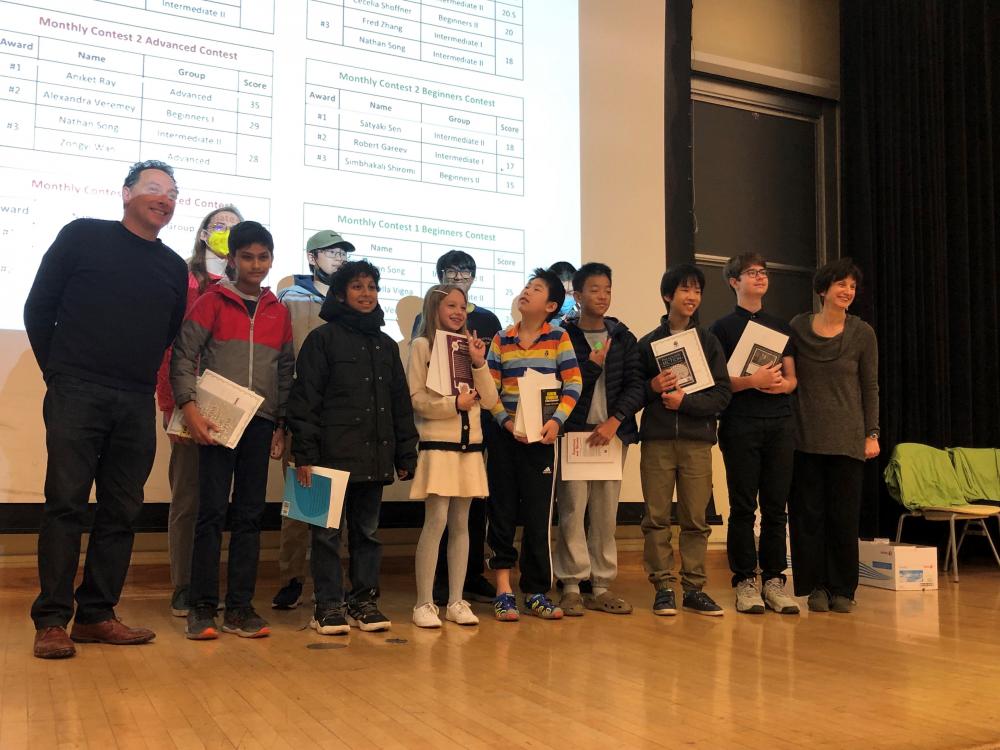
On Sunday, May 7th, BMC-Upper brought another excellent semester to a close with its Spring 2023 colloquium featuring a talk from Espen Slettnes, an accomplished research and contest mathematician and long-time friend of the Math Circle. Espen imparted wisdom gained from his substantial experience with math contests, including a walk-through of a problem of his own design. After his talk, we held an awards ceremony for all Spring 2023 Monthly Contest winners, with prizes hand-picked by Espen. With Espen now off to MIT, we were lucky to have him as a speaker, and the event was a resounding success!

Espen Slettnes receives a Gold Award at the 2022 United States of America Mathematical Olympiad (USAMO)!

Podcast with BMC director, Zvezda Stankova, in Numberphile!
Interview with BMC director, Zvezda Stankova, in Berkeley Science Review
Espen Slettnes publishes paper in Journal of Graph Algorithms and Applications!
Check out Espen's paper, "Minimal Embedding Dimensions of Rectangle k-Visibility Graphs," published in 2021's first issue of the Journal of Graph Algorithms and Applications!
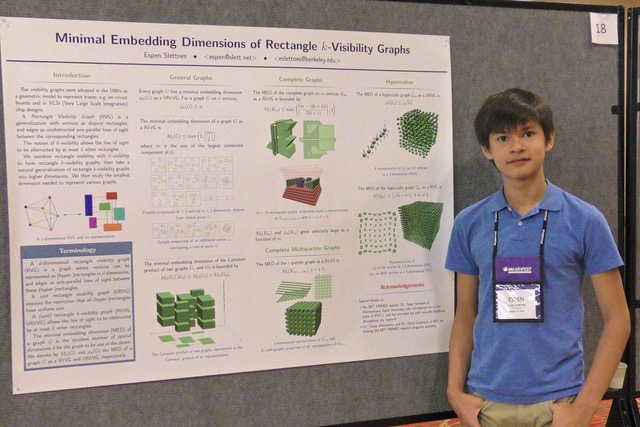
Espen Slettnes receives honorable at the 2020 United States Online Mathematical Olympiad (USOMO)!
The USAMO test is given to the top combined scorers on the AMC12 and AIME. Our very own math circler, Espen Slettnes, has distinguished himself among the 2020 USOMO participants!
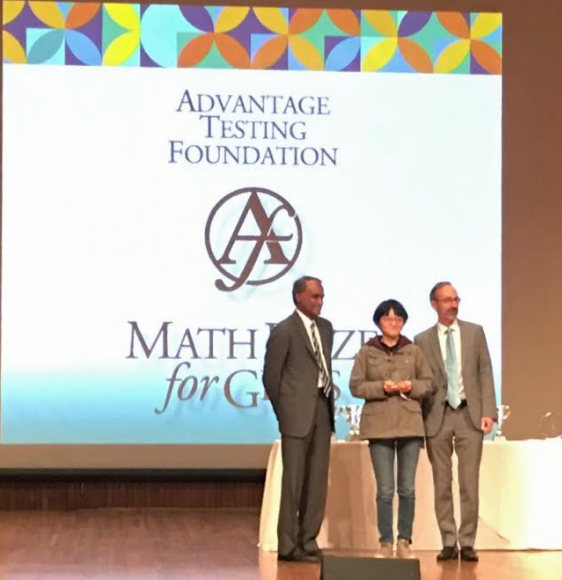
Hanna Hantao Chen Achieves at Math Prize for Girls!
Math Prize for Girls is the world’s largest math prize for young women high school age or younger. Hanna tied for 16th out of 300 girls, got an Honorable Mention, and was invited to the next round of competition!
Congratulations, Hanna!
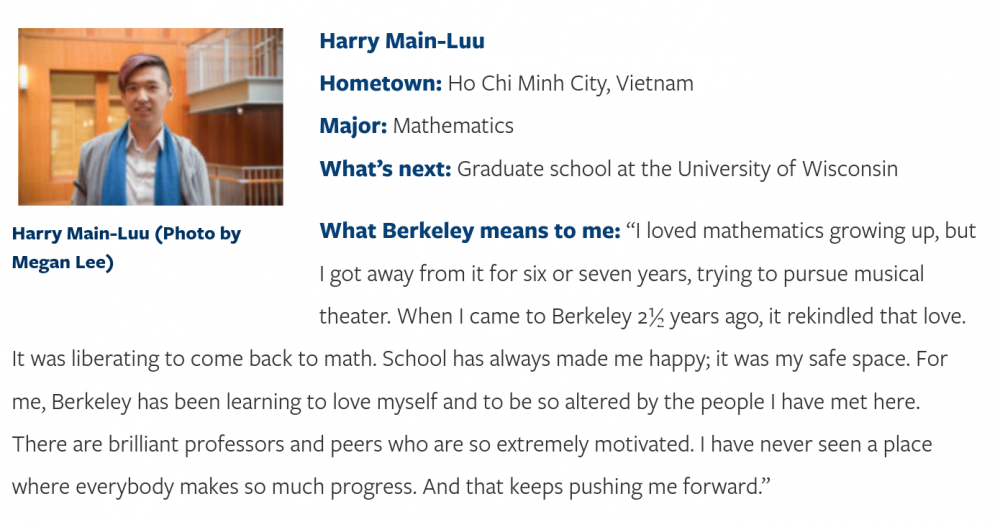
Harry Main-Luu, previous assistant for MTRW and BMC-Upper, was named one of the 4 UC Berkeley University Medal runners-up!
"Every year, the competition for the University Medal – the award given each year to the graduating senior who best embodies the highest ideals of UC Berkeley – is fierce. Candidates for the medal, which was established in 1871, must have overcome significant challenges, had an impact on the lives of others and carry a GPA of 3.96 or higher."
Read Harry's profile below:
Alumnus Evan O'Dorney continues success after BMC!
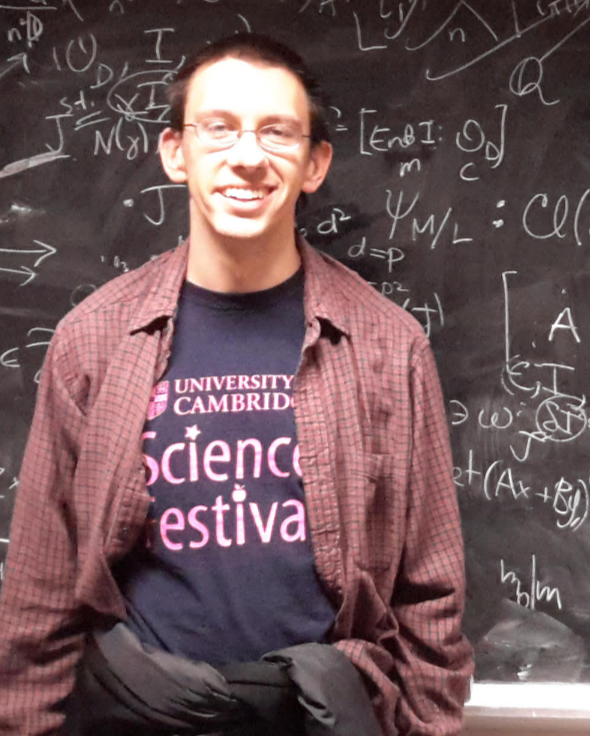
He finished the Mathematical Tripos in Cambridge and is now a Ph.D. student at Princeton under Manjul Bhargava. He was called on to write the music for a film advertising the Churchill Scholarship, by which he went to Cambridge. To read more about Evan and his time at the Berkeley Math Circle, visit the Program page.
Congratulations to Justin Lee for being a winner of the 10th United States of America Junior Mathematical Olympiad (USAJMO)!
The USAJMO test is given to the top combined scorers on the AMC 10 and AIME. Justin distinguished himself among 300,000 students who also participated in the American Mathematics Competitions.
Espen Slettnes Wins First Place at 2018 Broadcom MASTERS and Receives Minor Planet named after him!
Our very own seasoned math circler Espen continues to reap awards. Among more than 900 winners from regional science fairs in California, he went on to win both the 1st prize in Mathematical Science as well as Project of the Year Award across all categories in the junior division at the 2018 California Science and Engineering Fair.
In other math-related fields, he received a bronze medal at 2018 USA Physics Olympiad (USAPhO). He is also competing in the Gold division of the USA Computing Olympiad (USACO), having easily aced the Bronze and Silver divisions last year.
He has also been accepted as one of 45 pre-college students worldwide to form the inaugural cohort of World Science Scholars, a new initiative to nurture the next generation science researchers, led by Professor Brian Greene of Columbia University. The scholars will explore a broad range of new disciplines expanded from mathematics. The video above includes footage from MAA MathFest 2018 in Denver earlier this month; near the end, Espen is talking to Dr. Michael Pearson, executive director of MAA.
More recently, Espen won first place (out of 80,000 middle school students who competed) at 2018 Broadcom MASTERS! This competition is the premier science and engineering competition for middle school students and is a national science fair organized by The Society for Science and Public. He was also selected out of a gifted, national applicant pool to be named as a Caroline D. Bradley Scholar. He will receive a merit-based scholarship for high school.
MIT Lincoln Laboratory also just named a minor planet after Espen to recognize his achievements. His name will be added to the Minor Planet Center database (run out of the Smithsonian Astrophysical Observatory in Massachusetts). Look out for Minor Planet 34379 Slettnes in the sky!
Congratulations, Espen!
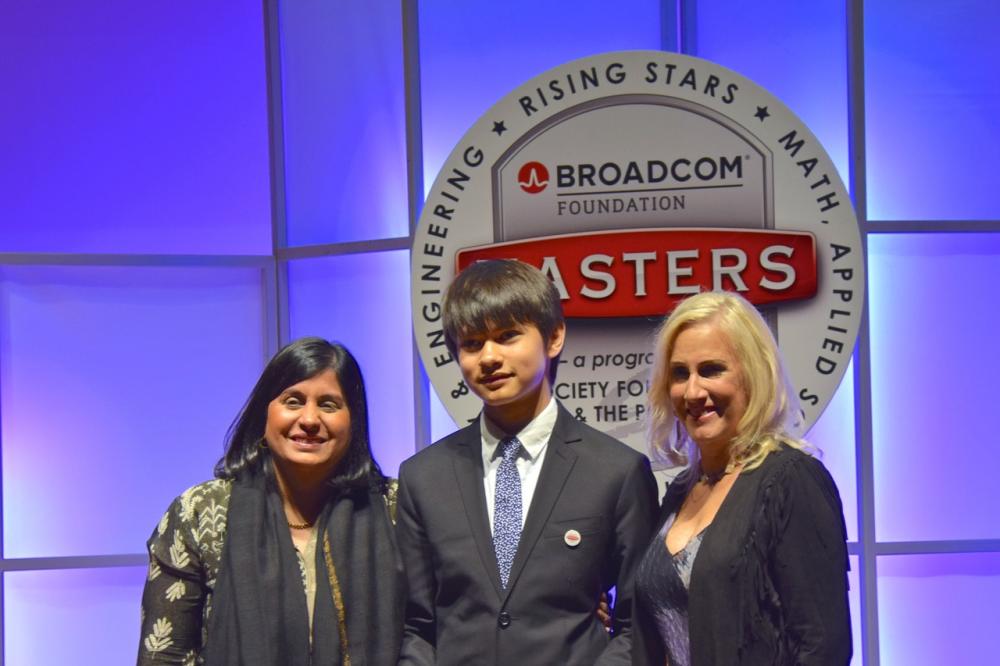
Espen at the 2018 Broadcom MASTERS competition in Washington, D.C.
Zach and Ave Golden awarded at the World Mathematics Team Championship
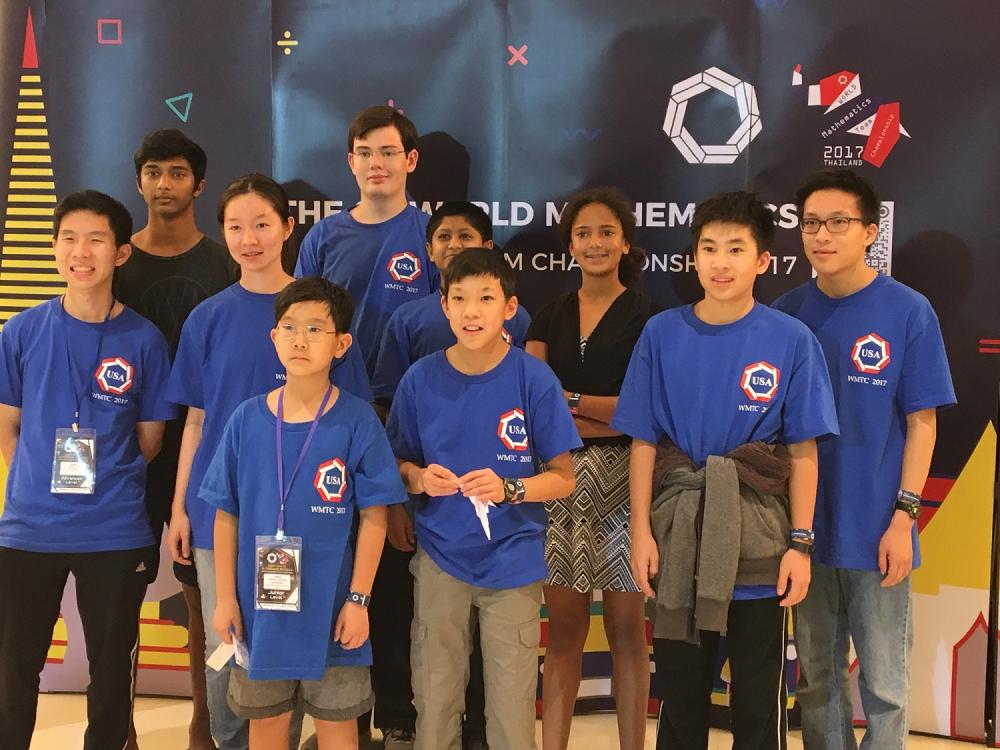
Zach (in black shirt) and Ave (in black cardigan), seasoned circlers, return to BMC with Bronze Award (for Zach) and Merit Award (for Ave), in the individual rounds at the World Mathematics Team Championship, held in Thailand in November 2017. Congratulations to this brother-sister team and thank you for continuing to reinforce the BMC name on the map. Welcome home!
Vinayak Kumar Earned Gold Medal at the WMTC
Vinayak returns to the Circle with a gold medal around his neck, placing 5th individually in the Advanced Division at the World Mathematics Team Championships. Congratulations, and welcome home!
BMC Alumnus Laura Pierson Continues to Reap Awards
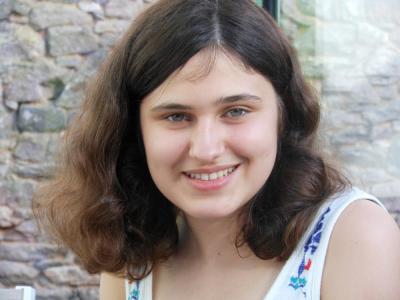
Seasoned circler and alumnus, Laura Pierson, keeps going on her mathematical journey with great success. She placed in the top five at the Math Prize Contest in 2016 among all girls in the U.S., earning herself a gold medal. This year, in the Regeneron Science Talent Search, she has been named the Top 300 Scholar. Her talent also earns her a spot in the top 40 finalists to compete later in the year. We look forward to hearing good news while cheering for her on this journey.
Bio: Laura is currently a senior in high school and still connected to BMC. She coordinates the Monthly Contest and the awards. She has also given lectures at the Circle. Laura won the USAJMO in 2015 while she was in 10th grade, placing in top 12. In 7th grade, Laura, being the youngest member of the USA team, won a silver medal at the European Girls' Mathematical Olympiad (EGMO) in Luxembourg.
BMC Alumnus Evan Chen Continues His Passion for Math!
.jpg)
Evan Chen is a PhD student in math at MIT. He is one of the coaches of the USA IMO team, serving as the assistant academic director at the American summer training program (MOP), the editor-in-chief of the USA national math olympiad (USAMO), and the coordinator for the USA IMO team selection. Evan is also the author of a popular textbook Euclidean Geometry in Math Olympiads used by students preparing for mathematical olympiads. As a high school student, Evan was himself an IMO gold medalist and winner of the 2014 USAMO (which he took from 12:30am to 5am in Taiwan). Outside of math and teaching, Evan enjoys StarCraft and Korean pop dance.
Espen writes a poem!
BMC student Espen has written a beautiful poem called "My True Number". We wanted to share as it is quite appropriate for the Berkeley Math Circle! Please do not take out the poem without copyright.
My True Number
By Espen Slettnes, Jan 6th, 2014
My shadow and I stood in a complex plane.
"What value are you?" I winked and asked.
"3435i", said he, and he asked me mine.
I said I was 33+44+33+55.
"That's what I am, but times i"he replied.
Our eyes met and danced
as we added and multiplied and exponentiated and tertiated
until we reached the magnitude of beauty,
in the silence of ∞, where I saw my true self.
I spoke no words but the simple language of the universe.
I rose and vaporized into numbers,
integrated with the Universe,
and we became 1.
Footnotes:
- The complex plane is a way to represent all complex numbers in 2 dimensions. A complex number is made up of a real and imaginary part.
- i is the imaginary unit, defined as √ -1
- Tertiation is repeated exponentiation, which is repeated multiplication, which is repeated addition.
- ∞ means infinity - larger than any number
- (33+44+33+55) = 3435 (each digit raised to its own power)
Copyright © 2014 Espen Slettnes. All rights reserved.
Berkeley Math Circle featured on "The Monthly"!
The Berkeley Math Circle has been featured "The Monthly," East Bay's Premier Magazine of Culture and Commerce, titled "Proving Their Passion" by Sarah Weld. Check out the Berkeley Math Circle on the news here!
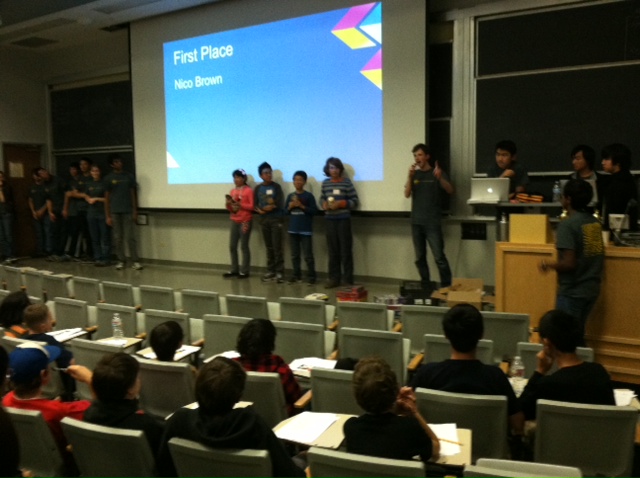
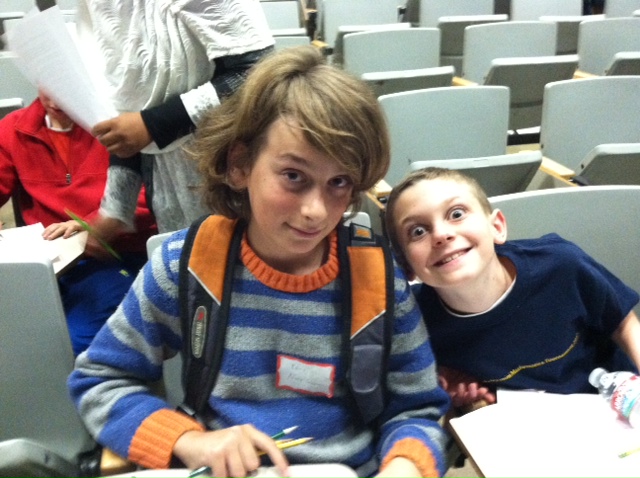
Nico Brown of the Berkeley Math Circle wins first place at the Berkeley Mini-Math Tournament!
|
|
BMC's own Nico Brown won the Berkeley mini Math Tournament (BmMT). The middle school student variant to the BMT for high school students, this past weekend.
Nico's score in the Individual round placed him into the top six students who entered the final Countdown elimination round, a series of timed questions... and he emerged the overall champion!
He wouldn't have got there without Team BMC coached by Intermediate Circle parent Tor Slettnes--Vincent Pisani, Arav Karighattam, Nate Fish, Espen Slettnes, and Nico--so congratulations to all!